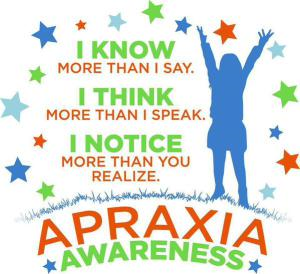
 Remember Broca’s Aphasia? When you know what you want to say, but the words just won’t come? Well, there’s another speech disorder that presents this way. It is known as Apraxia of Speech (AOS).
Like aphasia, there is a disconnect between what the brain thinks and what the mouth can say. However, AOS differs in that the brain is comprehending and sending language just fine. It is the neurological signals for motor control that have been disrupted. The mouth knows what to say, and the muscles are plenty strong enough, but it just can’t move the way it needs to in order to make the sounds.
There are two types of apraxia: acquired apraxia of speech (AAOS) and childhood apraxia of speech (CAOS).
CAOS is present at birth and is typically diagnosed between ages 2 and 4, when severe language delays are noted, as well as difficulty in forming the mouth in lips when speaking. CAOS is categorized as a developmental disorder. Its cause is usually unknown, but may be genetic as it appears to be present when there is a family history of communication disorders. More boys than girls are diagnosed with CAOS.
AAOS is much more common in adults than children. Acquired apraxia is caused by brain injury, such as an accident, stroke, or tumor. It can co-occur with both aphasia and dysarthria.
As with any communication disorder, apraxia can be downright frustrating for those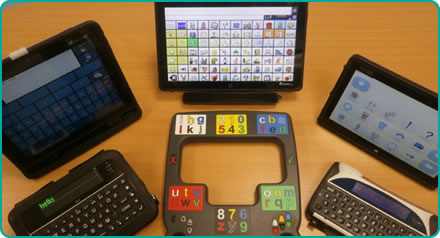 struggling to put their thoughts, needs, and desires into words. Because of this, most children with apraxia are taught sign language or use an Augmented Alternative Communication Device (AACD), which are kind of like keyboards made of pictures.
Speech therapy is the common treatment for apraxia of either type. Oral placement therapy (OPT) can help to train the muscles to know where they need to be for certain sounds, similar to the way you learned to type on your keyboard without looking at the keys
Below is an example of the OPT for apraxia. You can see how the therapist alternates the use of the shapes and her own fingers to help this client feel how her mouth should feel when making the sound correctly.
The NIH website has an excellent explanation of apraxia for further reading.
 carefully:
 Aphasia
 Blank Spaces