Apraxia of Speech

Apraxia of Speech

Image result for apraxiaRemember Broca’s Aphasia? When you know what you want to say, but the words just won’t come? Well, there’s another speech disorder that presents this way. It is known as Apraxia of Speech (AOS).

Like aphasia, there is a disconnect between what the brain thinks and what the mouth can say. However, AOS differs in that the brain is comprehending and sending language just fine. It is the neurological signals for motor control that have been disrupted. The mouth knows what to say, and the muscles are plenty strong enough, but it just can’t move the way it needs to in order to make the sounds.

There are two types of apraxia: acquired apraxia of speech (AAOS) and childhood apraxia of speech (CAOS).

CAOS is present at birth and is typically diagnosed between ages 2 and 4, when severe language delays are noted, as well as difficulty in forming the mouth in lips when speaking.  CAOS is categorized as a developmental disorder. Its cause is usually unknown, but may be genetic as it appears to be present when there is a family history of communication disorders. More boys than girls are diagnosed with CAOS.

AAOS is much more common in adults than children. Acquired apraxia is caused by brain injury, such as an accident, stroke, or tumor.  It can co-occur with both aphasia and dysarthria.

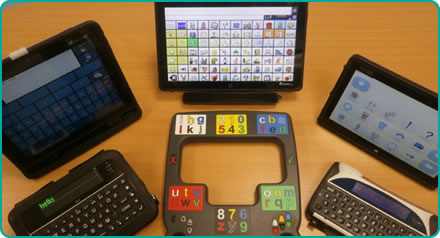
As with any communication disorder, apraxia can be downright frustrating for thoseImage result for augmented communication devices struggling to put their thoughts, needs, and desires into words. Because of this, most children with apraxia are taught sign language or use an Augmented Alternative Communication Device (AACD), which are kind of like keyboards made of pictures.
Speech therapy is the common treatment for apraxia of either type. Oral placement therapy (OPT) can help to train the muscles to know where they need to be for certain sounds, similar to the way you learned to type on your keyboard without looking at the keys

Below is an example of the OPT for apraxia. You can see how the therapist alternates the use of the shapes and her own fingers to help this client feel how her mouth should feel when making the sound correctly.

The NIH website has an excellent explanation of apraxia for further reading.


Dysphasia

Dysphasia

How many of you have eaten today?

Did you make sure to follow these steps carefully:

  1. Place a bolus on your back molars
  2. Focus on bilaterally chewing
  3. Sweep your tongue across your teeth to move the chewed bolus towards your throat
  4. Ensure your epiglottis is closed
  5. Engage muscles of the throat as you moved the chewed bolus into the esophagus, sending it to the stomach

If you are like 73% of people, you didn’t think about any of these steps. You just put the food in, chewed and swallowed, probably while thinking about your schedule, driving, or reading your phone.

So, what of the other 23% of the world’s population? These have been diagnosed with dysphasia, a swallowing disorder.

Dysphasia is common after a stroke, or some medications. It can be neurological or biological based, causes by muscle weakness or nerve damage.

The most current treatment for dysphasia is electrical muscle stimulation (e-stim) therapy. Electrodes are attached to the face and neck, over the effected muscles. Then, low-level electrical pulses are sent through muscles when assistance is required to swallow. Essentially, e-stim gives a boost to the muscles’ movement, similar to a spotter when weightlifting.

While far more common in the older population, dysphasia can occur in children. My brother “Henry” struggled with dysphasia when he was a year old. Due to the lack of therapists trained locally in E-Stim, my mom, two of my sisters, and “Henry” lives out of state on week every month for nine months so he could receive therapy 6 hours/day 6 days/week. Thankfully, the therapy worked, and today the child who gagged on one milliliter of formula eats as well as any other six year old.

Dysarthria

Dysarthria

Since beginning college, everyone asks me what I want to do with my degree. The conversation nearly always goes like this:

“I want to be a speech-language pathologist.”

“Oh.” *awkward pause*

“It’s like a speech therapist.”

“Okay, so you help kids with stutters and stuff.”

*I hesitate trying to gauge the person’s level of interest, then give up*

“Sure, something like that, yes.”

When people think of what I want to do, they picture dysarthria. Essentially, dysarthria is the inability to speak clearly, due to weak muscles. It is thus categorized as a motor communication disorder. Dysarthria is a physical symptom of a neurological disorder, not a disorder in itself. It is commonly a side effect of stroke, Lyme disease, cerebral palsy, multiple sclerosis, some medications, as well as many others. (click here for the Mayo Clinic’s site)

Example of dysarthria (approx. 7 min)

bite_tube_set2_1024x1024
TalkTools’ Bite tubes: commonly used for speech therapy

The most common type of therapy used in treating dysarthria is Oral Placement Therapy (OPT). OPT uses a variety of  techniques to help train (or re-train) weak muscles. This is done with a variety of tools, some employing vibration of stimulate muscle movement. An example of a OPT technique is demonstrated in the video here(approx 1 min)

Because it is a physical nature, the therapy for dysarthria is exhausting. OPT is basically a workout for the muscles of the mouth, throat, abs, and lungs. Those coming out of a session of therapy or practice at home will likely be completely worn out, and have muscle pain, like you would after lifting weights, or going for a long run. It isn’t uncommon for patients to have hours of practice per week.

When attempting to communicate with someone with dysarthria, be patient and  compassionate. Remember they are well aware something is “not right” with how they speak, and they are probably working very hard to improve.

Aphasia

Aphasia

A national survey from 2016 stated nearly 85% of Americans had never heard of aphasia, let alone understood what it was. Of those who knew the word, 35% knew it was associated with language. Only 8.8% of Americans both recognize the word “aphasia” and can define it.

As aphasia effects nearly two million Americans (more people than cerebral palsy, Parkinson’s, or multiple sclerosis) I believe it is important for us to understand what it is, what it does, and how we can help individuals effected.

BrocasAreaSmallAphasia originates in the brain. There are two areas of the left hemisphere of the human brain that deal with speech and language, the Broca’s and Wernicke’s areas (see left). 

The Wernicke’s area takes words into the brain, whether spoken or written, process them, then send them to the Broca’s area. Its job is language comprehension. The Broca’s area then formulates the words and sends them to the mouth. Its job is production. Aphasia occurs when damage is done to either of the areas, or to the communication between them.

Because each of these areas has a different function, when they are damaged, they present differently, and are named by the area damaged. Wernicke’s aphasia is known as fluent aphasia; Broca’s aphasia is called non-fluent aphasia.

Imagine you are having coffee with a friend. She’s sharing the story of her frantic search for lettuce one hour before an important dinner party.

“I was pushing the cart down the aisle, looking for the… um, the… the…”

She scowls in frustration, and continues.

“There it was, so I grabbed a head and took it to the checkout.

When I got home I realized I had the wrong type of… um… the, uh…”

Your friend is demonstrating a classic case of Broca’s (non-fluent) aphasia. The speaker cannot make the words they are looking for actually exit their lips. The brain comprehends language, takes in information, creates the word, but can’t make the mouth say it. This can lead to an incredible sense of frustration.

Imagine instead of the conversation having odd blanks in the vocabulary, it went something like this:

” I had the elevator quick the basket cat, and bonnet snap.”

This sentence of nonsense is common with Wernicke’s (fluent) aphasia. Their comprehension of language has been effected but not their ability to speak. Typically, the speaker has no concept that they haven’t said what they meant to say or that they make no sense.

Aphasia is a common side effect of stroke. Strokes happen when blood to the brain has been interrupted for any length of time. This can happen from trauma or blood clotting in the brain or brain stem.

The usual treatment for aphasia is speech therapy. Broca’s aphasia has a higher recovery rate simply because the patient comprehends what is wrong and can work to fix their speech. The amount of language recovery depends on how fast a stroke is caught and treated as well as how quickly therapy is begun after treatment.

Here are videos demonstrating the two types of aphasia:

Sarah Scott, Broca’s Aphasia (1.5 min)

Wernicke’s Aphasia example (1.5 min)

There is one main side effect of aphasia that has nothing to do with the body. The lack of ability to effectively communicate effects an individual’s social skills. One study

PX-HelenandSarah
Sarah Scott had a stroke at 18 and was diagnosed with Broca’s Aphasia. 10 years later, she is the face of Aphasia Awareness.

asked people with aphasia to take three different tests evaluating their sociability, networks size, and sense of belonging. The results were startling. Of all the relationships evaluated, marriages were the social network most devastatingly affected. People with aphasia scored their social isolation lower than levels of clinical depression. And all due to the fact that they couldn’t speak effectively.

The best way to help a person with aphasia, the best way to show them kindness, is to be patient. Don’t avoid a conversation because you think it will embarrass them.

Reach out. Make an effort. Be kind.

Because in the end, they’re just people.

click here to learn more about aphasia


Welcome

Welcome

Speech is power: speech is to persuade, to convert, to compel.

— Ralph Waldo Emerson

Imagine you have no speech. When you do speak, your words are garbled, not the word you meant to say, or simply won’t come out of your mouth. This is the daily reality of those struggling with aphasia or dysarthria, two common communication disorders.

Over the next few weeks, I will discuss aphasia and dysarthria, their causes, types, treatments, and effect on everyday life. I’ll also talk about how we can help those struggling with communication disorders.

Thank you for stopping by.